
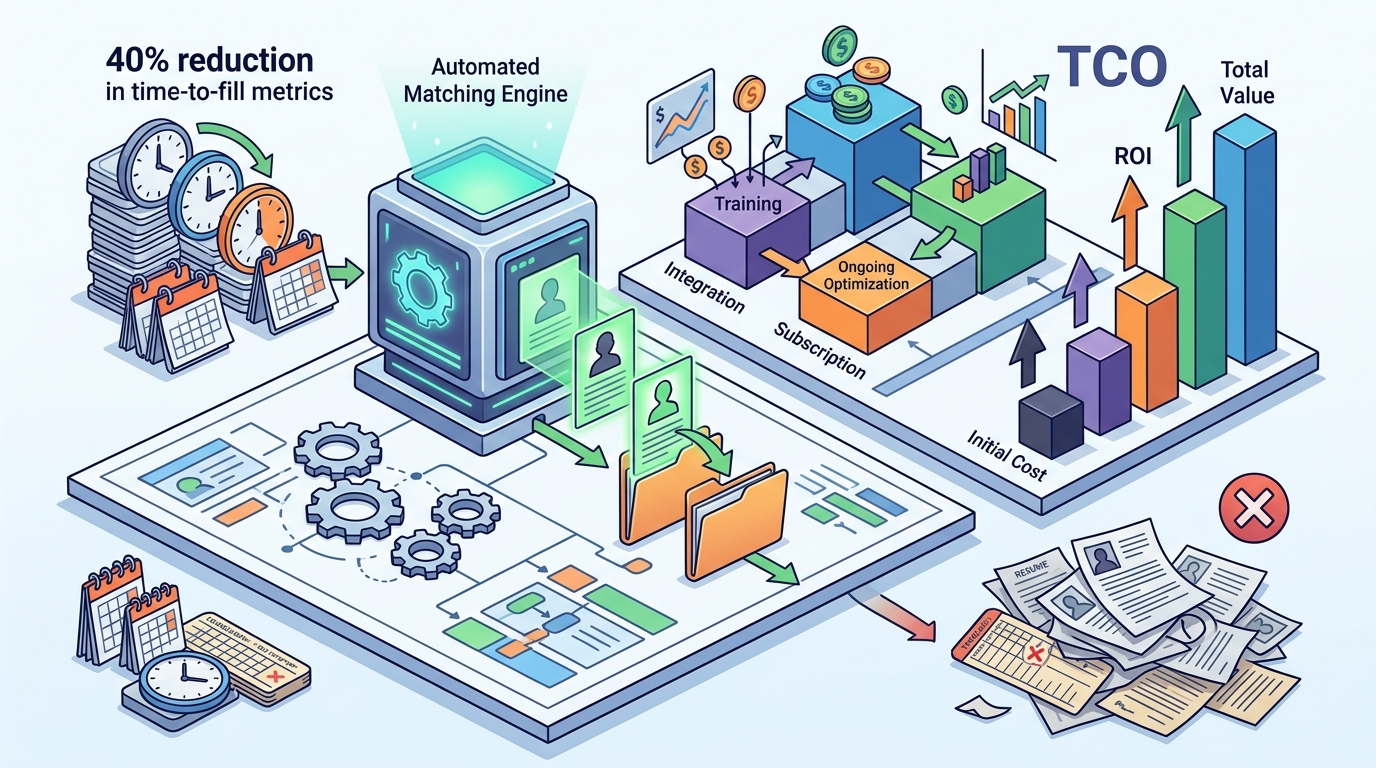
Organizations that integrate intelligent hiring platforms report a 40% reduction in time-to-fill metrics within the first year of deployment. This statistic highlights the critical shift from manual administrative burdens to automated, data-driven decision-making. However, calculating the true financial impact requires looking beyond the initial subscription price. The total cost of ownership (TCO) involves implementation, integration, training, and ongoing optimization. Understanding these layers is essential for securing executive buy-in and ensuring long-term success.
Understanding Total Cost of Ownership
Total Cost of Ownership (TCO) is the comprehensive financial estimate of a recruiting tool's purchase, deployment, and maintenance over its entire lifecycle. Many organizations fail because they focus solely on the license fee. This narrow view ignores the significant operational costs associated with integrating AI into existing workflows. A robust TCO analysis includes software licensing, hardware infrastructure, personnel training, and potential productivity dips during the transition phase.
When evaluating AI recruiting solutions, it is vital to distinguish between one-time setup costs and recurring operational expenses. One-time costs include data migration, API integration, and initial configuration. Recurring costs encompass monthly subscriptions, customer support tiers, and continuous model training to ensure accuracy. According to industry benchmarks, companies that neglect TCO analysis often see a 20% higher effective cost due to poor integration and low user adoption rates.
Direct vs. Indirect Cost Breakdown
Direct costs are the most visible expenses. These include the annual subscription fee for the AI platform and any additional costs for premium features like advanced analytics or candidate sourcing tools. For example, a mid-sized enterprise might pay between $10,000 and $50,000 annually for a comprehensive suite. These figures are straightforward and easily budgeted.
Indirect costs are often more damaging to the bottom line. These include the hours spent by HR professionals learning the new system, the time required to clean and migrate historical candidate data, and the potential loss of productivity during the learning curve. If an AI tool fails to integrate seamlessly with your existing Applicant Tracking System (ATS), you may incur additional development costs for custom connectors. Furthermore, poor candidate experience due to technical glitches can damage your employer brand, leading to higher costs in future recruitment cycles.
AI recruiting is the application of machine learning algorithms to automate and enhance various stages of the hiring process. This definition encompasses everything from resume parsing to interview scheduling. By automating repetitive tasks, recruiters can focus on high-value activities like relationship building and strategic planning. This shift directly impacts the return on investment by increasing the capacity of your recruiting team without increasing headcount.
Key ROI Metrics to Track
To accurately calculate ROI, you must track specific performance indicators before and after implementation. The primary metric is time-to-fill. AI tools can reduce this time by automating initial screenings and scheduling. A reduction from 45 days to 30 days represents a significant cost saving in terms of recruiter hours and job posting fees.
Another critical metric is cost-per-hire. This includes advertising costs, agency fees, and internal labor. By reducing reliance on external agencies and optimizing job ad spend through AI-driven targeting, companies can lower this figure substantially. Additionally, quality-of-hire is a long-term ROI driver. AI can help predict candidate success based on historical data, reducing turnover rates. Lower turnover means less spending on re-hiring and re-training.
Data shows that organizations using AI for resume screening see a 75% reduction in time spent on initial reviews. This efficiency gain allows recruiters to engage with more qualified candidates. When calculating ROI, multiply the hours saved by the average hourly wage of your recruiting staff. This figure provides a tangible baseline for the software's value.
Strategic Advantages of Connected Recruiting
Match2 offers a unique approach to recruiting by focusing on connected candidate solutions. Unlike traditional ATS platforms that silo data, Match2 emphasizes the integration of candidate information across multiple touchpoints. This connected approach reduces data redundancy and improves the accuracy of AI-driven insights. By leveraging advanced assessment capabilities, organizations can ensure that the data feeding their AI models is high-quality and relevant.
The platform's architecture is designed to minimize integration friction. This reduces the indirect costs associated with custom development and maintenance. Furthermore, Match2's focus on platform features that prioritize user experience ensures higher adoption rates among recruiters. Higher adoption leads to better data collection, which in turn improves the AI's performance over time. This creates a positive feedback loop that enhances ROI.
Understanding the types of recruiting strategies supported by the platform is also crucial. Match2 supports both active and passive candidate sourcing, allowing for a more comprehensive talent pool. This breadth of coverage can reduce the need for expensive job board postings. By optimizing the sourcing mix, companies can achieve a lower cost-per-hire while maintaining high quality standards.
Implementation Challenges and Mitigation
Implementing AI recruiting tools is not without challenges. Data privacy and compliance are major concerns. Organizations must ensure that their AI tools comply with regulations like GDPR and CCPA. Failure to do so can result in significant fines and reputational damage. Choosing a vendor with a strong commitment to security and compliance is essential.
Another challenge is change management. Recruiters may resist AI tools if they perceive them as a threat to their jobs. To mitigate this, organizations should focus on the augmentative nature of AI. Emphasize how the tools free up time for strategic work. Providing comprehensive training and support is also critical. Match2 provides resources to help teams navigate this transition, ensuring a smoother adoption process.
Technical integration can also be complex. Legacy systems may not support modern API standards. This can lead to data silos and inefficiencies. Selecting a platform with robust integration capabilities, such as those offered by Match2's feature set, can help avoid these pitfalls. Regular audits of the integration health can also prevent issues from escalating.
Key Takeaways
- Total Cost of Ownership includes both direct license fees and indirect costs like training and integration.
- AI recruiting is the application of machine learning to automate and enhance hiring processes.
- Key ROI metrics include time-to-fill, cost-per-hire, and quality-of-hire.
- Organizations using AI for resume screening see a 75% reduction in review time.
- Connected candidate solutions reduce data redundancy and improve AI accuracy.
- Data privacy compliance is a critical factor in vendor selection.
- Change management and training are essential for successful AI adoption.
Frequently Asked Questions
What is the average ROI for AI recruiting tools?
While ROI varies by industry and company size, many organizations report a 200% to 300% return on investment within the first two years. This is driven by reduced time-to-fill and lower cost-per-hire.
How does AI impact the cost-per-hire?
AI reduces cost-per-hire by automating sourcing and screening, which lowers the need for external agency fees and reduces the time recruiters spend on administrative tasks.
What are the main risks of AI recruiting?
Primary risks include algorithmic bias, data privacy violations, and low user adoption. Mitigating these requires careful vendor selection, regular audits, and comprehensive training.
How long does it take to see ROI from AI recruiting?
Most organizations begin to see measurable ROI within six to twelve months. This timeline depends on the complexity of integration and the speed of user adoption.
Is AI recruiting suitable for small businesses?
Yes, AI recruiting tools are scalable and can benefit small businesses by providing enterprise-level insights and automation at a fraction of the cost of traditional methods.
How does Match2 differ from traditional ATS platforms?
Match2 focuses on connected candidate solutions, integrating data across multiple touchpoints to provide a more holistic view of the candidate journey. This approach enhances the accuracy of AI-driven insights.
What training is required for AI recruiting tools?
Training requirements vary by platform. Most modern tools offer intuitive interfaces and comprehensive support resources. Match2 provides dedicated resources to help teams navigate the transition effectively.
Can AI recruiting tools handle compliance regulations?
Leading AI recruiting platforms are designed to comply with major regulations like GDPR and CCPA. However, organizations must still ensure their usage practices align with these standards.
Next Steps
Calculating the ROI and TCO of AI recruiting tools is a strategic imperative for modern HR departments. By understanding the full financial landscape and leveraging connected candidate solutions, organizations can optimize their hiring processes and achieve significant cost savings. To explore how Match2 can help you achieve these goals, contact our team today for a personalized demo and consultation.